
The Boomerang Nebula: A Star’s ඞ Suspicious ඞ Death
When astronomers pointed their telescopes at the constellation Centaurus, they weren’t expecting to see a cosmic crewmate. The Boomerang Nebula bears an uncanny resemblance to the characters from Among Us, the viral 2018 social deduction video game.
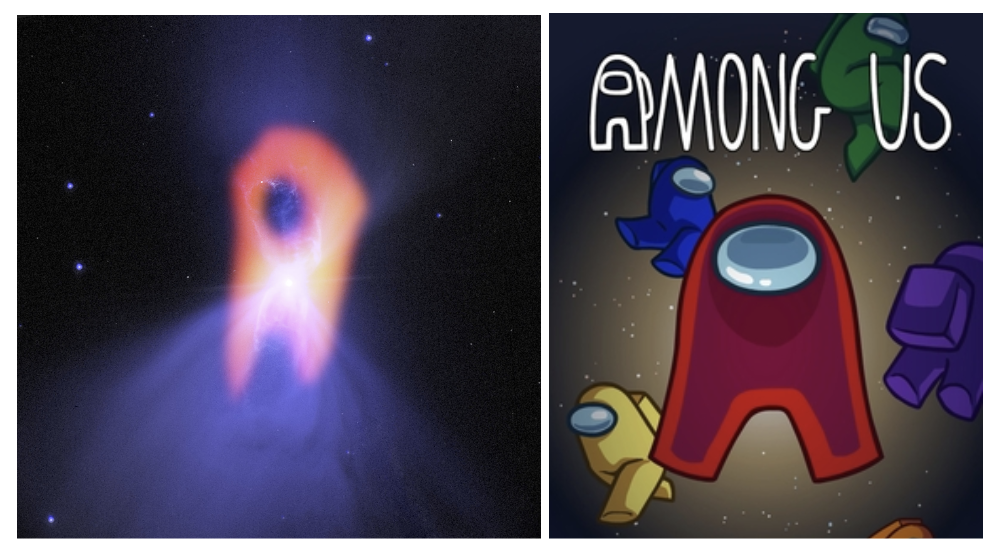
Figure 1. (Left) The Boomerang Nebula (7), with its cold gas observed by the Atacama Large Millimeter Array (ALMA) radio telescope (orange) and the Hubble Space Telescope (purple). (Right) A crewmate floating in space from the game Among Us (1).
Beyond its unusual shape, the Boomerang Nebula is an interesting model for studying how stars die. Formed from the glowing remnants of a dying star, this nebula was created when the star expelled its outer layers of dust particles and ionized gases into space. One would expect these energetic outflows to heat its surroundings. However, this nebula actually holds the record for being the coldest place in the universe, revealing the extraordinary physics behind a star’s final moments.
Shaping the Boomerang Nebula
The first images of the Boomerang Nebula in 1979 were described as a “butterfly” or “bow-tie” shape (10). Unable to see the details that we now observe with more powerful telescopes, astronomers only saw a ghostly curved outline, leading them to name it the Boomerang Nebula.
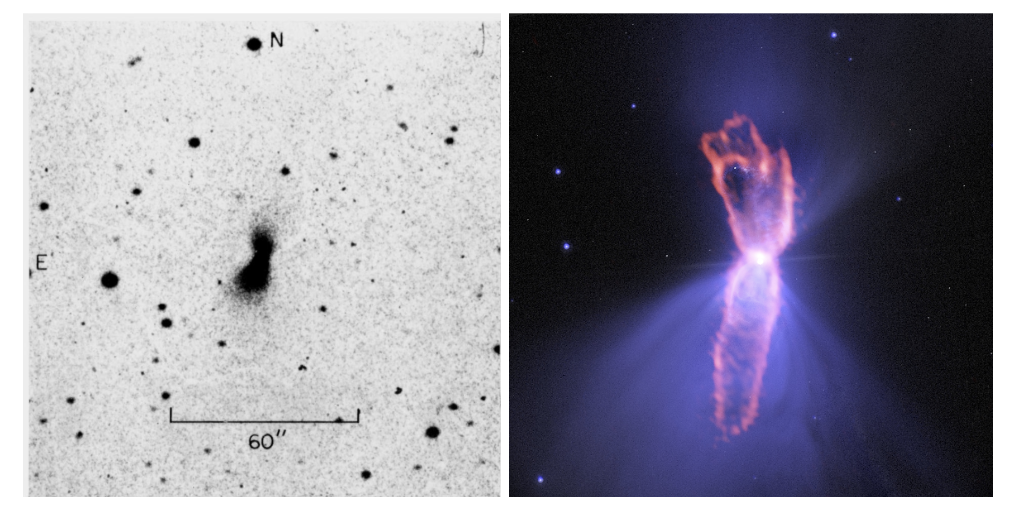
Figure 2. (Left) In 1977, Wegner and Glass discovered an unusual “butterfly” nebula in prints from an existing sky survey. They followed up with observations using a 1.88 m telescope to capture this image (11). (Right) In 2014, ALMA captured our most detailed image of the nebula to date, revealing its extended ultra-cold outflow and hourglass shape shown in orange (5).
It wasn’t until 2014 when the ALMA radio telescope returned to the Boomerang Nebula, revealing what was really there: an hourglass-shaped outflow stretching across three trillion kilometers (6). For context, that's about one-third of the distance from Earth to the nearest star, Proxima Centauri!
This staggering structure was created from a single dying star. The Boomerang Nebula is a planetary nebula, which marks the final evolutionary stage for stars similar to our Sun. When a star exhausts the hydrogen fuel in its core after billions of years, it can no longer support itself against gravitational collapse. As a result, the star becomes unstable, leading to pulsations that shed its outer envelope out into the nebula.
However, the Boomerang does not resemble a typical planetary nebula, which tends to appear as symmetrically expanding bubbles of gas. Instead, it features a narrow hourglass shape, produced by jets emerging from its central dying star.
Astronomers suspect that these jets were triggered when the central star engulfed a smaller companion, injecting additional energy that propelled its outflows. As a result of the merger, the combined system rotates more rapidly and twists the star’s magnetic field lines. These magnetic field lines act like rigid tubes that guide charged gas vertically from the poles of the star (10). Therefore, the outflow is funneled into narrow, high-speed jets rather than escaping uniformly. These jets lead to two key observational effects. First, they carve holes through the dense, dusty central region, allowing the star’s light to escape from its poles (7). Second, the jets themselves illuminate the surrounding ultra-cold gas as it is expelled into space (5).
The Coldest Place in the Universe
At first glance, these energetic jets might suggest that the Boomerang Nebula is warm and heated. Yet in 1997, scientists found that its temperatures plummet to less than 1 degree above absolute zero, the theoretical point where all atomic motion ceases (8). In fact, the Boomerang Nebula is the coldest place we’ve found in the universe. As of now, this is the only known location that is even colder than the cosmic microwave background radiation, which permeates all of space (3).
But how does this happen? You might have guessed: the answer lies in the world of physics. The dying star at the nebula’s center is releasing massive amounts of gas at extraordinary speeds: about 590,000 km/hr, roughly 10 times faster than what’s typical for a dying star (8). This gas rushes outward into the vacuum of space, expanding rapidly into a region of much lower pressure.
This process is known as adiabatic cooling. When gas expands without gaining heat from its surroundings, energy is required for the gas molecules to spread apart. That energy comes from the motion of its own molecules. Less molecular motion then means lower temperature, allowing the Boomerang Nebula to cool to such extremes.
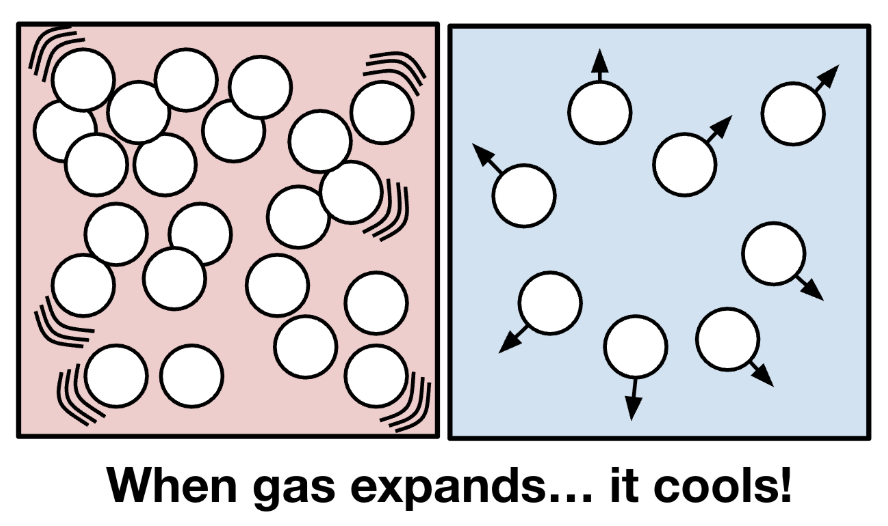
Figure 3. Illustration of adiabatic cooling: rapid gas expansion draws energy from its molecular motion, driving the Boomerang Nebula’s extremely cold temperatures.
A short-lived extreme of stellar evolution
This extreme cooling is not permanent, but is the consequence of an unusually brief and violent phase of stellar mass loss. The dying red giant star at the Boomerang Nebula’s center has been shedding 1/1000th of its mass per year (4). Eventually, the outflows that drive its cooling will slow and the nebula’s temperature will gradually dissipate into its surrounding environment.
Currently, the Boomerang provides a rare opportunity to examine the cascade of stellar death in action. Recent observations with the ALMA radio telescope have mapped the nebula’s carbon monoxide emission (8), which traces the winds ejected from the central star (2).
Together, these efforts suggest that the Boomerang Nebula still has much to reveal about the final stages of a star’s life, combining its mysterious shape with the coldest temperatures observed in the universe. Its ultimate fate may be to fade quietly, but the Boomerang’s extreme physics remains a suspicious outlier among dying stars. This astrophysical ‘impostor’ will continue to challenge and refine our understanding of how stars end their lives.
References
Among Us. Innersloth, 2018. iOS/Android game.
Bohigas, J. "An analytical model for the evolution of the coldest component of the Boomerang Nebula." Monthly Notices of the Royal Astronomical Society 466.2 (2017): 1412-1420.
European Space Agency. “The Boomerang Nebula - the Coolest Place in the Universe?” ESA/Hubble, 20 Feb. 2003, esahubble.org/images/heic0301a/.
NASA Hubble Mission Team. “Boomerang Nebula.” Science.nasa.gov, 23 Mar. 2008, science.nasa.gov/missions/hubble/boomerang-nebula/.
National Radio Astronomy Observatory. “ALMA Returns to Boomerang Nebula, “Coldest Object in the Universe” - National Radio Astronomy Observatory.” National Radio Astronomy Observatory, 18 Feb. 2021, public.nrao.edu/gallery/alma-returns-to-boomerang-nebula-coldest-object-in-the-universe/.
National Radio Astronomy Observatory. “The Ultra-Cold Outflow of the Boomerang Nebula.” National Radio Astronomy Observatory, 12 Mar. 2021, public.nrao.edu/gallery/the-ultra-cold-outflow-of-the-boomerang-nebula/.
Sahai, R., et al. "ALMA observations of the coldest place in the universe: The Boomerang nebula." The Astrophysical Journal 777.2 (2013): 92.
Sahai, Raghvendra, and Lars-Åke Nyman. “The Boomerang Nebula: The Coldest Region of the Universe?” The Astrophysical Journal, vol. 487, no. 2, Oct. 1997, pp. L155–59. Crossref, doi:10.1086/310897.
Schmidt, D. R., et al. "ALMA Observations of CO in Five Planetary Nebulae: Insights into Nebular Shaping." The Astrophysical Journal 992.1 (2025): 98.
Verhamme, Olivier, et al. "Magnetically driven winds from accretion disks in post-asymptotic giant branch binaries." Astronomy & Astrophysics 684 (2024): A79.
Wegner, G., and I. S. Glass. “A New Bipolar Nebula in Centaurus.” Monthly Notices of the Royal Astronomical Society, vol. 188, no. 2, Sept. 1979, pp. 327–30. Crossref, doi:10.1093/mnras/188.2.327.
